| 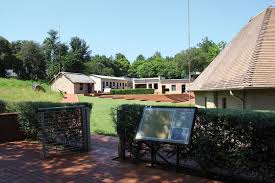 It was to be the last meeting at the secret headquarters of the banned African National Congress. The leadership had been worried for some time that the police had learned of their hideout on a smallholding in Rivonia, 20 kilometres north of Johannesburg. It was to be the last meeting at the secret headquarters of the banned African National Congress. The leadership had been worried for some time that the police had learned of their hideout on a smallholding in Rivonia, 20 kilometres north of Johannesburg.
In the afternoon of 11 July, 1963, a dry-cleaning van drove up to the door. No-one had ordered dry cleaning. Armed policemen burst out . . . and from that moment, the word "Rivonia" became synonymous around the world with the silencing of black resistance in South Africa.
The headquarters were on a smallholding called Liliesleaf Farm. The key leaders of the armed wing of the banned ANC, including Nelson Mandela himself, had operated from its outhouses for two years. In those days, Rivonia consisted of a rural patchwork of smallholdings, riding schools and farms, with few tarred roads. Today, it has been engulfed by the northern expansion of Johannesburg, to become one of the city's most upmarket suburbs.
The Liliesleaf building still stands today, just one more bungalow-style house in a quiet side street, but the grounds have been sub-divided and sold off. Now there are plans to set up a Liliesleaf Trust, restore the area, and perhaps even turn it into a conference retreat for international negotiations, on the lines of the US retreat Camp David.
The outbuildings that belonged to the farm are now part of adjacent properties but these will be purchased in the coming months so as to restore the farm as it looked when the ANC bought it in 1961 for use as an underground base for the newly-formed Umkhonto we Sizwe (MK), the armed wing of the ANC.
Mandela moved into the house in October 1961, while evading security police. He masqueraded as the gardener and cook, under the alias of David Motsamayi.
In December 1961, artist and designer Arthur Goldreich and his family moved in as the "legitimate" white owners of the house and as a cover for the covert MK operations. Goldreich was unknown to the security police, but he was one of the first members of MK. While Goldreich lived in the main house, the other ANC members lived in the outbuildings, to allay suspicions concerning blacks living in the "white" house.
Mandela describes the swoop on Liliesleaf in his autobiography Long Walk to Freedom: "On the afternoon of 11 July, a dry cleaner's van entered the long driveway of the farm. No one at Liliesleaf had ordered a delivery. The vehicle was stopped by a young African guard, but he was overwhelmed when dozens of armed policemen and several police dogs sprang from the vehicle. In the [the thatched cottage] they found a dozen men around a table discussing a document."
That document turned out to be the plan and outline of Operation Mayibuye, the MK plan for guerrilla warfare in South Africa. The men in the room were Raymond Mhlaba, Govan Mbeki, Lionel "Rusty" Bernstein, Walter Sisulu, Bob Hepple, Ahmed Kathrada and Denis Goldberg. Mandela himself was absent - he was serving a five-year sentence on Robben Island for inciting workers to strike, and for leaving the country without a passport. Goldreich drove into the farm while the raid was in progress, and was also arrested. Mandela says in his book: "In one fell swoop, the police had captured the entire High Command of Umkhonto we Sizwe."
It is significant that for a "terrorist" group planning sabotage, not one weapon or bomb was found on the property.
Mandela was brought up to Pretoria from the island, having served nine months of his five-year sentence, and together with the other top MK members, was charged with sabotage, a crime carrying the death sentence. Says Mandela: "From that moment on we lived in the shadow of the gallows."
On 12 June 1964 sentence was handed down by Judge Quartus de Wet: "I have decided not to impose the supreme penalty which in a case like this would usually be the proper penalty for the crime, but consistent with my duty that is the only leniency which I can show. The sentence in the case of all the accused will be one of life imprisonment."
Seven men were taken to Robben Island - Sisulu, Mhlaba, Mbeki, Kathrada, Elias Motsoaledi, Andrew Mlangeni and Mandela. Bernstein, although he helped draft the MK constitution, was found not guilty and discharged. Hepple was released after agreeing to become state witness, but immediately fled to England with his wife.
Goldberg was the only white sentenced to life imprisonment, for which he was sent to Pretoria Central Prison. Most of the men served between 22 and 27 years in prison, Mandela being the last one released in February 1990.
| 
