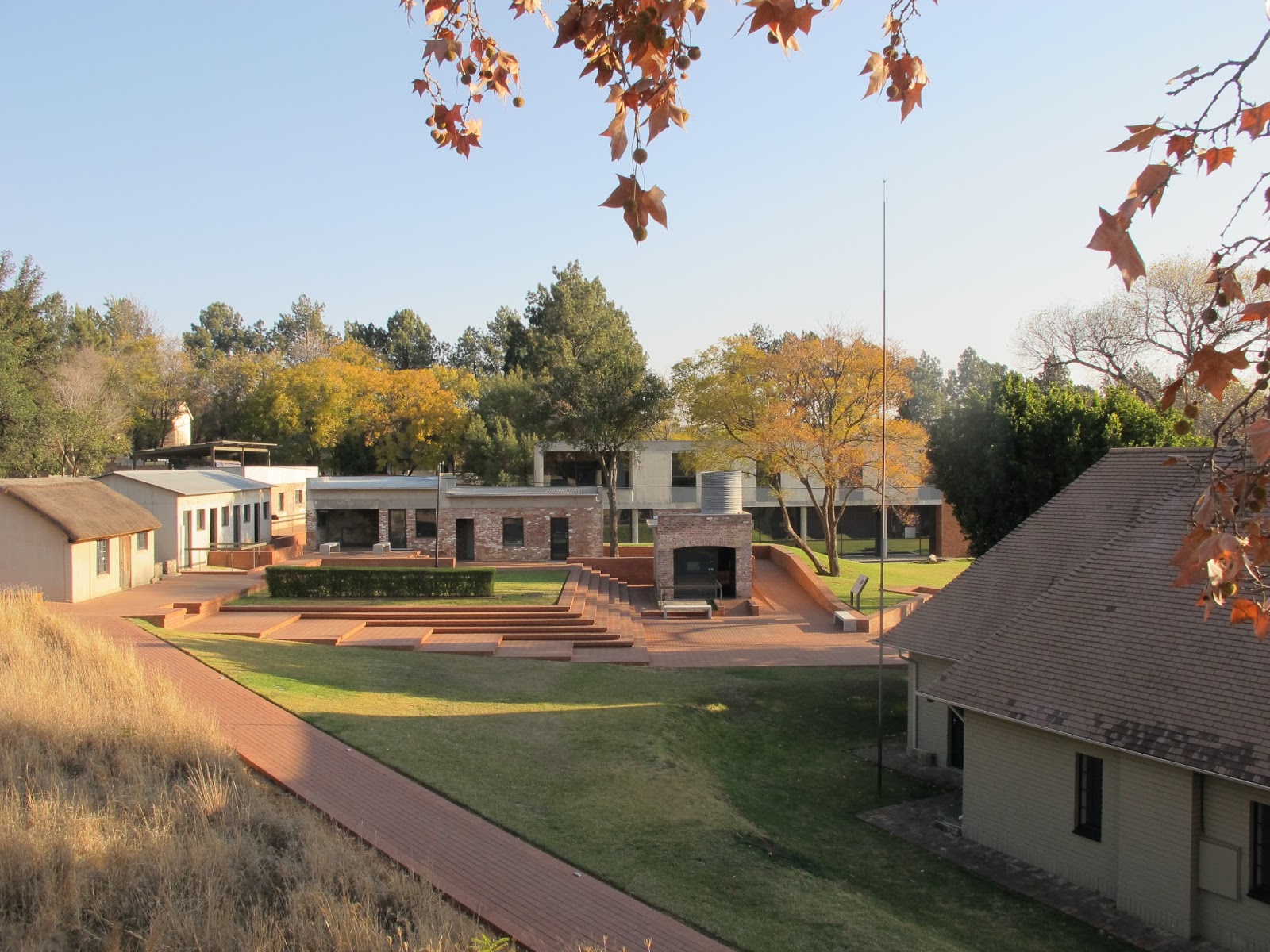
 Rivonia is very different these days, thanks to Johannesburg's residential march northwards. So much so that when Mandela tried to find Liliesleaf Farm eighteen months after his release from prison, accompanied by journalist Allister Sparks, he spent some time searching the suburb before finding the farmhouse - and surprised the present owners, Veda and Helmut Schneider. Rivonia is very different these days, thanks to Johannesburg's residential march northwards. So much so that when Mandela tried to find Liliesleaf Farm eighteen months after his release from prison, accompanied by journalist Allister Sparks, he spent some time searching the suburb before finding the farmhouse - and surprised the present owners, Veda and Helmut Schneider.
When the Schneiders bought the house in 1989, they were unaware of its historic value. But several weeks after they moved in, the Sunday Times published a picture of the house, with a caption reading: "Mystery buyer snaps up plotters' hide-out".
"This was the first time we got to know about what we had bought," says Veda Schneider. Over the next several years overseas visitors knocked on their door and asked to look around the house. Then more local people came to look, as did the Sandton Historical Society, conducting an informal tour of the house, says Schneider.
"By 2000 we had started to talk seriously about turning the house into a guest house, and when the house next door became available for rent, we thought the time was right," says Schneider. The couple moved next door and started renovating the farmhouse.
A year later, in February 2001, Liliesleaf opened as a three-suite luxury guest house and conference centre. It has become a most attractive place: gleaming parquet floors in the entrance foyer welcome the visitor. Carefully selected furniture, pictures and mirrors, with converted gas fireplaces, make up the public rooms.
It has just recently received its five-star rating, and with a staff of 10, hosts up to three conferences a week.
In December 2001, a reunion of the Rivonia trialists was held, to celebrate the 40th anniversary of the formation of MK. Some 150 guests were invited, along with President Thabo Mbeki. Mhlaba, Goldberg, Mlangeni, Bernstein and Goldreich were present; Mandela and Kathrada couldn't attend; Sisulu was in hospital; Govan Mbeki and Motsoaledi had died.
At this function it was announced that the Liliesleaf Trust had been formed. The object of the Trust is to return the house and the outbuildings where the trialists lived, to their original state, and create a museum to record this history.
Three surrounding properties will be purchased, and a hotel and conference centre will be erected, overlooking the original house. "It will be a case of deconstruct and reconstruct," says Nicholas Wolpe, administrator and co-ordinator of the Liliesleaf Trust. The plotters' confiscated printing press and radio transmitter will be returned to the house.
But it won't simply be a matter of restoring the physical items to their original place, it has a deeper significance, says Wolpe. "We want to capture the symbolic importance of the leadership that gathered at Liliesleaf. It was the best group of leaders this country has ever seen. We want to create an awareness and understanding of what the struggle was about."
Wolpe says it will take around R50-million to achieve the vision. Consultants have already been commissioned to assist in getting a roadshow together, to start fundraising for this project. It is expected that the restored Liliesleaf Farm will only be operational in two years' time. When asked how she felt about leaving the house and all that has been built up, Schneider says: "The idea was always to have a trust - it's the right way for it to go. There will be sadness at giving up the guest house, but I am glad we had a part to play. I am delighted the trust has been established."
The trust has a broad vision for the Farm. "America has Camp David. England has Chequers. Now South Africa will have a similar retreat, where government, institutions and the private sector can gather in historic surroundings," say Wolpe.
| 
