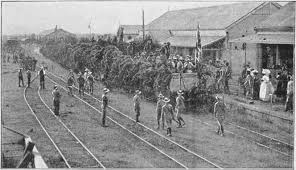
 In Boksburg, police attempting to disperse a crowd fired over the heads of strikers. Fire was returned, wounding several policemen. Police were ordered to fire into the crowd, leaving three dead and many wounded. In Boksburg, police attempting to disperse a crowd fired over the heads of strikers. Fire was returned, wounding several policemen. Police were ordered to fire into the crowd, leaving three dead and many wounded.
Public reaction to the deaths showed clear support for the strikers: shops were closed in Boksburg on the day of the funeral, with a two-mile long procession. In Johannesburg more than 5 000 strikers and sympathisers gathered.
Smuts was warned that "the Rand was drifting into revolution" but he remained reluctant to conduct an inquiry, and said: "We should let things develop", a statement that some say he lived to regret for the rest of his life.
The Federation approached the Chamber for a meeting to review the situation with the possibility of getting the mines running again, but the Chamber rejected any further meetings. The Chamber added that they from now on did not recognise the Federation.
This was it for the Federation - they called a national strike, and were not against violence being used. Tramwaymen and slaughtermen joined the strike on 5 March, and thousands marched down Rissik Street in downtown Johannesburg. They marched past the Post Office and the Trades Hall, where both the Communist Party and Federation had their headquarters.
Shorten sums it up: "A revolt against the State was now inevitable."
Commandos started arming themselves, even using swords and bayonets and home-made weapons. Assaults on scabs increased and strikers tried to pull clerks out of shops, the Post Office, the Telephone Exchange and Park Station.
On 7 March more deaths occurred in a clash between whites and blacks at the New Primrose Gold Mine, when armed black miners fired at strikers and then rushed at them. The clash ended with the police trying to separate the sides, with two policemen and two blacks killed, and 20 blacks wounded.
The following day more deaths occurred in Brixton, Ferreirastown and Vrededorp: seven people died, six of them blacks. The strike leaders urged strikers to desist from attacking blacks.
The temperature was rising, with calls on Smuts to declare martial law, but he still hesitated. On 9 March citizen force regiments were called in. In an effort to disperse the crowds, Smuts decided to use military aircraft to fly low over the gatherings and fire red warning flares. If this didn't work, machine guns were to be fired above strikers' heads. A final step was to attack the gatherings.
Violence swept across the Rand, engulfing the mines, railway property, and police stations, including a brutal attack at the Brakpan mine in which four mine officials and three policemen were killed. Police stations across the reef were attacked and seven stations - from Krugersdorp in the west to Edenvale in the east - taken over by strikers. At the police station at Hamburg on the west Rand, a solitary sergeant demanded a receipt when handing over the station.
This day, Friday, 9 March, became known as "Black Friday" - Johannesburg was at war.
| 
