 Throughout history, governments have gone to great lengths to obliterate traces of their conquered enemies: they have destroyed religious temples and buildings, killed men and taken their women and children as their own, imposed new languages and cultures on these people. The South African government of 1922 buried their enemy as paupers and then laid out a nursery over these graves, thus concealing them. Throughout history, governments have gone to great lengths to obliterate traces of their conquered enemies: they have destroyed religious temples and buildings, killed men and taken their women and children as their own, imposed new languages and cultures on these people. The South African government of 1922 buried their enemy as paupers and then laid out a nursery over these graves, thus concealing them.
Strikers and sympathisers pour into the streets outside the city library, leaving a solitary tram stranded in the middle, as the Rand Revolt heats up
The enemy in 1922 were striking white miners, who clashed with the government of General Jan Smuts in a terrifying confrontation that brought bombs and shells raining down on Johannesburg, killing about 150 people.
For decades, the mystery has been: what happened to those who died? A number of pauper graves have recently been discovered in the Braamfontein Cemetery in Johannesburg, buried under a nursery. It is believed they are the graves of white mineworkers who died in clashes with the army and police in 1922. Now, in 2002, the nursery is to be cleared and grassed and the National Union of Mineworkers - now largely black - is to erect a memorial.
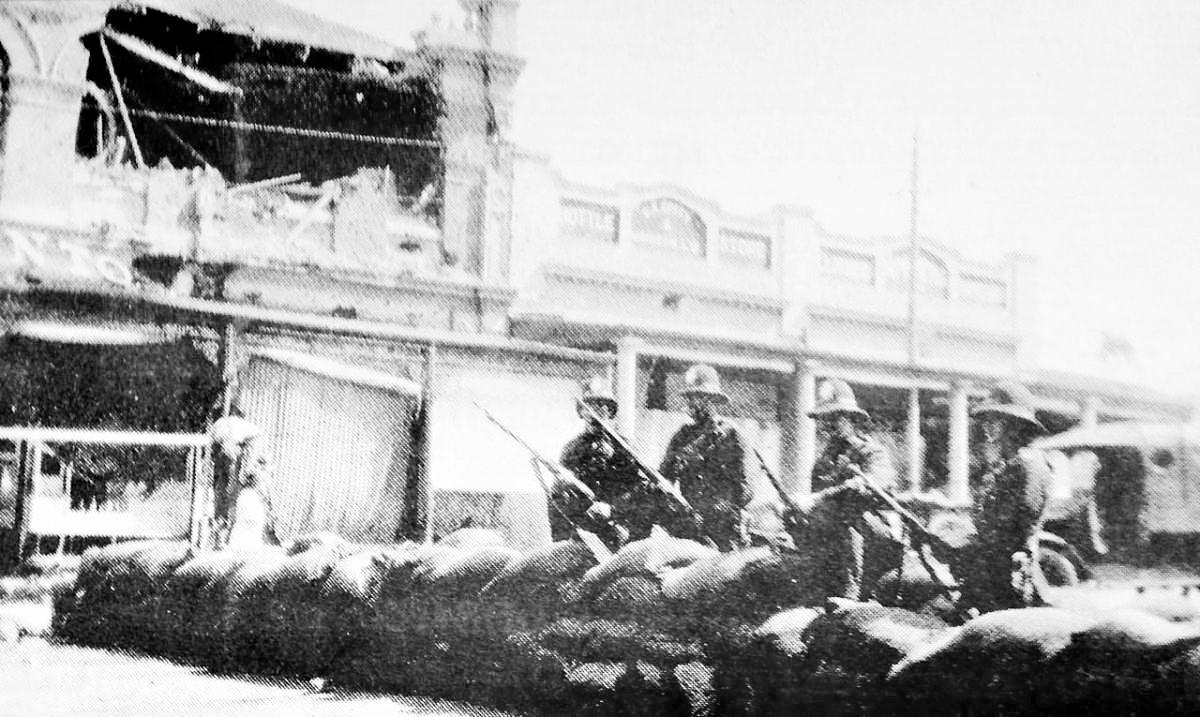
It's hard to imagine that 80 years ago Johannesburg was at war: planes were dropping bombs on Fordsburg, several buildings in Brixton were shelled, commandos of mineworkers were marching through central Johannesburg. Trains lines were dynamited, and civilians were attacking police stations and disarming police officers and taking them prisoner.
This was the 1922 mineworkers strike and it lasted almost three months before it was quelled, but not before martial law was declared.
General Smuts became prime minister in 1919, and many historians believe the most difficult period in his political career faced him in the following four years. World wool prices had fallen, as had produce prices, the diamond market had fallen and secondary industry was depressed. Retail trade fell, precipitating a drop in wages and retrenchments. The cost of living had risen 23% and rents were being raised, according to an account by historian John Shorten in The Johannesburg Saga.
|

